Critical Reflection
Chapter 1: Listening to Her Louder
Throughout Unit 3, I was getting deeper into the world of my inner child and not just as a subject of research, but as a studio partner. Where previous phases of my MA journey had started to explore the inner child through imagery and nostalgia, this phase was more bodily, more vulnerable, and more emotionally charged. I wasn't just representing her anymore, I was allowing her to speak.
My degree show artwork was the turning point. I finally felt that I did something with her as opposed to about her. I surrendered more, and my inner child was able to write, scribble, and cry onto the canvas. The act of surrender cracked something open in my practice which was a development towards rawness and emotional honesty. It was no longer just about childhood as a memory, but of childhood as presence, as energy still alive through in the body and soul.
I returned to beading, but differently. The stitching were not decorative, they were meditative and sometimes intentionally felt unfinished. I perceived these processes not just as ways of making, but as ways of listening. The materials themselves like the thread, sparkling beads, pastels offered ways of emotional language. Thread was both wound and repair.
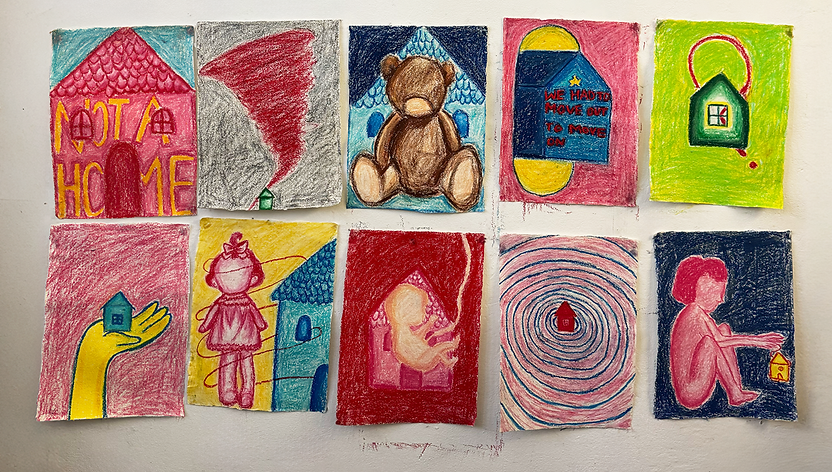
More recently, I’ve switched to work on paper, not a shift from canvas but a desire for something that feels more intimate. To me, paper felt like it could hold more intimacy in ways that canvas cannot. It's like remembering the journals, the pages you hold close to yourself. The ten symbolic works that I did on paper during this unit feel like confessions and psychological, not narrative, an inner world shaped by childhood but not dictated by it.
In Unit 3, my research deepened into questions of emotional memory, the house as a psychic space, and the possibility of healing through playful methodologies. Rather than to answer these questions, my work chose to hold them. In doing so, I started to listen more clearly to the voice of the inner child and not louder, but more clearly. And I kept listening.

Welcome to my house, 2025
Close ups
Chapter 2: Emotional Mark-Making
Throughout this phase in my practice, I was increasingly becoming more interested by how materials carry emotion and how a mark, stitch, or smear of pastel is able to hold memory and express feeling. I began to think about making as feeling: the mark as emotion, and drawing or stitching as a kind of somatic language.
For my MA degree show piece, I did this even further, by allowing raw emotional language enter the work, not just through image, but text as well. Words like "Where are you? ", "I'm sorry", and "I'm angry" were scribbled over the painted house, written in a way that resembled the urgency of childhood tantrums or secret diary pages. These weren't neat or carefully constructed additions, they were spontaneous, sometimes desperate.
The writing itself became another layer of vulnerability. Stitching, as well, began to shift. Before, I feel like I would use thread decoratively within my work, but this time I began using it more symbolically. Some stitches formed uneven Xs, others were abruptly cut off, others dripped loose with colorful bead. Stitching into the canvas became physical and meditative, almost like tracing the contours of old pain with my hands. Also, what surprised me about the process is how physical it became. Stitching was not only symbolic but it also felt somatic. Something I noticed was that I often found myself holding my breath as I pulled the needle through the canvas or pressing harder when the emotion behind a phrase was heavier. The act of making was not separate from the feeling, it was one and the same. At times the thread would knot or tangle, and instead of cutting them out, I began to accept them as part of the work. These moments became quiet records of the process itself: not mistakes, but pauses, interruptions, or rhythm changes. I began to understand that the more emotionally tuned in I was, the less I tried to make it neat and perfect. Stitching became a way of exploring the feeling.
The tension in my work grew more intentional: scribbles that spiraled out of control, unfinished lines, childish shapes that were a little too messy or too sad. I wasn't trying to copy a child's drawing, but to give the child in me permission to draw and she doesn't always want to stay inside the lines. This freedom, this emotional mark-making, became a way to let her speak through gesture.
Homes I carry, 2025
Chapter 3: The House, Revisited
The house continued to appear in my work throughout Unit 3, shifting between painting, drawing, and even experimental photography. While I noticed in Unit 2 the house was still emerging as a visual motif, it feels like in Unit 3 it became more stable like a recurring presence through which I could process complex emotional states. Sometimes the house existed as shelter, sometimes asa burden. Its form was always symbolic, conditioned not by realism or perspective but by how it felt. The house, in my work, became a space for grief, for longing, and for repair and it evolved through different materials and methods. I once read something by the French philosopher Gaston Bachelard and he writes that “a house that has been experienced is not an inert box” (Bachelard, 2002, p.55), which suggests that domestic space holds emotional weight beyond its physical form.
I did 10 drawings which began as quiet entries in my sketchbook, short lines of words and simple drawings that emerged almost without my thinking. I would sit with emotional memories and listen, and let the words come up without overthinking them. "We had to move out to move on" was one of the first things that rose. Another writing was "I had to go into the house to meet her again," referring to a guided meditation I once did where I mentally returned to my childhood house to meet my inner child. These short, poetic texts were raw, spontaneous responses to emotional landscapes that had not yet formed in visual terms. The act of writing led naturally into sketching. One flowed into the other.
What came next was not a decision to illustrate those words, but to expand them symbolically into drawing. I moved from sketchbooks to larger paper not because I wanted the drawings to be more refined, but because I wanted to give them more space to breathe and declare themselves.
I worked with oil pastels because they allowed for immediacy, a kind of mark-making that almost mirrored the emotional urgency of the writing. I wanted the message the feeling to be loud and direct. The drawings are not neat or careful. They are blunt. These are not house drawings, but emotion statements in the form of houses.
They result from a process that was more symbolic in nature within and less realistic or accurate. The house becomes a recurring structure, but not a stable one. In one of the drawings, it's being next to a tornado. In another, it contains a child, a womb, or a wound. One house boldly says, "NOT A HOME." Another says, "We had to move out to move on." These drawings do not offer literal memories. They map out emotional truths about displacement, longing, chaos, and tenderness.
What unites the drawings is their boldness. There is a kind of clarity that comes from emotional honesty. The drawings exist somewhere between symbolic storytelling and also intuitive memory. They are not exactly representations of my past, but they are an invitation into an inner space that is still very much alive.

Chapter 4: Photographic Play
Photography continued to surface in Unit 3 as a quite but still important element in my practice. I don't consider the photographs as final artworks, but I do think of them as visual sketches -intuitive and experimental images that help me expand the emotional language of my practice.
I returned to the dollhouse that I had painted earlier in my MA degree show, but now with a different approach. I disrupted it, broke it apart slightly, and began to photograph it in a different setting which was a playground. This wasn't a literal return to childhood, but a symbolic one. I chose the playground as a location because it holds emotional weight. It is a place built for children, yes, but also for imagination, for chaos, for vulnerability.
In these pictures, I'm with the dollhouse. I'm holding it sometimes, and just sitting beside it, looking at it. The photographs weren't posed in a traditional sense, but they were intentional. There was something so powerful in letting the house become a presence, not just a motif anymore. The photographs reflect a quite and gentle kind of tension between me and the house, between memory and the present, between holding on and letting go.

Getting photographed with the dollhouse felt strangely revealing. It wasn't an object I painted or simply stood next to any longer, it was a kind of emotional witness. In some of the photographs I'm holding it, in others I'm simply next to it, but always there is a quite conversation between us. The fact that my own body was in these photographs felt significant: I was not just observing the house; I was encountering it, confronting it, and sometimes protecting it. That dynamic between object and body almost felt like a performance of care, a physical way of returning, not to recreate the past, but just to acknowledge it.
This wasn’t about documenting the work necessarily, but more about allowing the camera to witness something unfolding. These photographs became another way for me to sit with the house, not to fix it or rescue it, but to understand it as something broken and fragile, yet still mine. It's part of my wider ecosystem of thinking. The photographs became a way of looking at the house's symbolic weight through a different lens and not as a fixed subject, but as something alive and emotionally charged.

Do Ho Suh: Walk the House
Chapter 5: Emotional Architectures
Throughout Unit 3, my practice has continued to ask: what is it to return to the child within, not to just represent her, but to listen to her? I have found that the answers lie less in resolution than in construction and in building emotional architectures from memory, play, and feeling. The house, for me, became a basic structure through which emotional truth could be explored. It allowed me to hold multiple realities: pain and comfort, presence and absence, memory and imagination.
This symbol led me to investigate the work of artists who also use the house as more than a physical form. In Do Ho Suh's installations, the house itself is transparent, movable, a kind of ghost architecture that holds onto memory and identity. I visited his solo show at Tate Modern in the summer and was especially moved by the way his houses in fabric carried both presence and absence. They reminded me that home is also both a container of emotion and a phantom. His art helped me see that my own houses aren't static; they're inhabited by feeling. Suh’s immersive and large installations certainly kept me in awe, but also his stitched sketches and smaller drawings really stayed with me. Their simplicity carried emotional complexity. The colors are often bright, even playful, but what lies beneath is loaded with grief, confusion, or longing. I think I related to that contradiction, not the contradiction of medium, but of mood. To use childlike colours to speak about something darker. To hold both play and pain in the same frame. Seeing his work helped me recognize how far this symbol has travelled in my own practice and not just as a recurring motif, but as a language. It encouraged me to stay with the house, to let it repeat, distort, return again. His drawings made me reflect on how symbols don’t just illustrate feelings- they become sites where meaning builds, accumulates, and even transforms over time.
After a tutorial with a great tutor, I was recommended to check out an artist called Louise Bourgeois. And indeed, I found a quiet resonance with Louise Bourgeois's house drawings. While I don’t work in the same medium and tone, I somehow connected with her use of the home as a deeply emotional and, sometimes, disturbing presence. Her houses are often closed off, claustrophobic, and even repetitive, almost psychologically entrapping. While my houses are simpler and more raw, I appreciate how she works with the home not just as shelter, but as psyche.
The idea of the psyche as space, and space as a kind of interior architecture, has become increasingly important in my mind. This was influenced not only by artists, but by personal practices like guided meditation, where I once imagined returning to my childhood home to meet and comfort my inner child. That experience stuck with me, and I believe it continues to shape how I think about space in my work: not just physical space, but internal emotional landscapes. I'm building not with walls, but with feelings.
Play continuous to be a vital methodology, not just in a light hearted or random way, but as an emotional point of entry. To play is to trust process. To return to childlike material, scribbles, or spontaneity is not to regress, but to tap into a part of the self that had previously been silenced or ignored. I don't use play as decoration, I use it to disarm, to soften, to connect.
I believe this way of working welcomes emotional complexity. A drawing can be vibrant and playful, yet carry a dense emotional weight. A stitched line can feel both tender and tense. Even my color palette reflects this : soft pastels and shapes often reveal deeper stories of loss, memory, or repair. I’m interested in how visual language can gently hold difficult emotions, not by hiding them, but by offering them through forms that feel open, disarming, and sincere.
Looking back, Unit 3 has deepened my emotional vocabulary through visual language. I’ve gone from surface nostalgia into something more intentional, a practice that makes space for healing, presence and emotional truth. The inner child is no longer just an reference or theme; she is a felt presence in the work. She doesn’t just symbolize the past; she helps me reimagine the future. Through playful forms, gestural boldness, and symbolic language, I have learned to trust the studio as a place of emotional repair. And maybe that’s what healing is, not a solution or an end destination, but a creative and ongoing act of listening.
Conclusion - A Self in Motion
This unit has played a significant role in the development of both my artistic and emotional practice. I am now more confident in my approach, more intentional in my use of material, and definitely way more open to experiment. Moving from literal depictions of childhood to more symbolic forms has allowed me to develop a deeper visual language, one that is emotionally engaging without relying on direct representation.
Throughout this unit, I noticed that I stayed really curious. I have been visiting galleries, looking at other artists' practices, and being open to new art influences. All of that helped me to expand in how I think about my own practice and helped me find more clarity. Not in the way of answers or absolutes, but in the way of knowing myself more. I understand now that the act of art making is also an act of self discovery, a way of listening inward while still being engaged with the world around me.
My practice this term has also been shaped by a more willing openness to trust play and intuition as valid methodologies. Play has become an emotional strategy, a way of accessing complexity through softness, spontaneity, and vulnerability. The inner child is no longer something I directly portray anymore, she has become part of how I see, feel, and make. Her presence is rooted in the emotional logic of my practice, not as a symbol of the past, but now as a collaborator in the present.
Finally, this unit has really affirmed to me the role of my studio practice as a place of inquiry, reflection, and even emotional repair. Rather than seeking “perfection” or neat resolutions, I have learned to stay with ambiguity and to hold space for grief, vulnerability, memory, and transformation. This has actually helped me proceed further in trusting emotional intuition and symbolic language as tools for healing and self-discovery.
Although the journey is yet far from complete, I now move forward with a more clear sense of my voice, my visual language, and emotional purpose that grounds my work. I leave Unit 3 not with closure, but with sincere gratitude for everything this process has allowed me to feel, to face, and to grow into.
Citations:
Bachelard, G. (2002) The Poetics of Space. Translated by M.J. Shields. 4th edn. New York: Penguin.